
Nothing’s Set in Stone: What’s Taking Place Beneath the Surface
By Tyjaha Steele
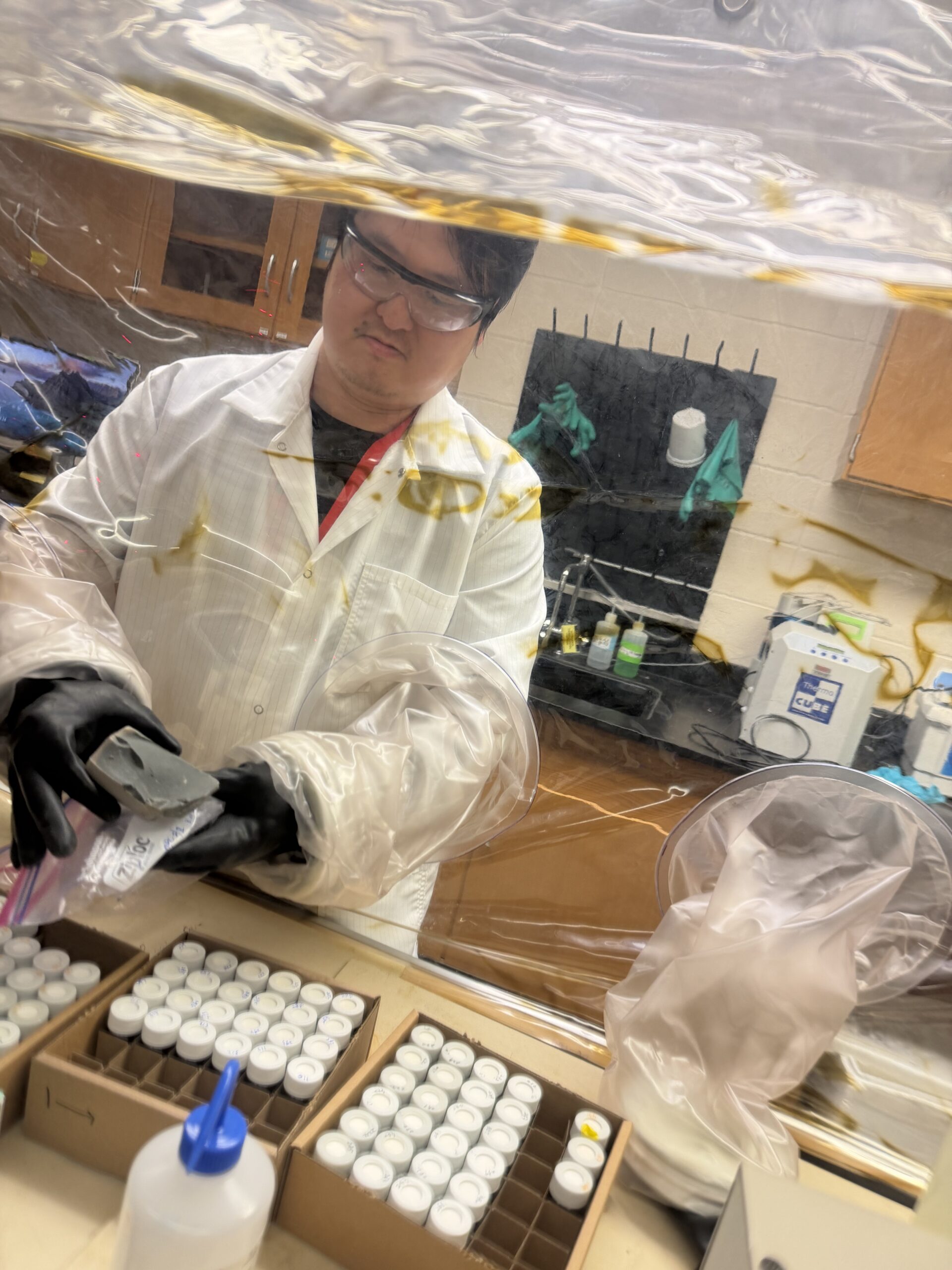
Peng Lin is shown working hands-on with cement in the lab (Photo courtesy of Peng Lin),
Although concrete is often seen as a stable barrier used to contain waste, it does not remain unchanged over time, and as it breaks down, it releases chemicals that can alter the surrounding groundwater. What happens when the materials designed to trap contaminants like uranium and strontium begin to change the conditions around them, and could those changes affect whether pollutants stay put or begin to move?
To answer this question, researchers from the University of Georgia’s Savannah River Ecology Laboratory (SREL), including Peng Lin, an assistant research scientist, and Daniel I. Kaplan, a senior research scientist, worked with collaborators from Savannah River Mission Completion (SRMC) and Closure & Disposal Determinations to examine how aging cement materials influence the movement of metals and radioactive elements in subsurface environments. Using sediments collected from the Savannah River Site (SRS) in Aiken, South Carolina, specifically from a subsurface low-level radioactive waste disposal area, the study explored how groundwater chemistry shifts as cement degrades and how those shifts affect contaminants such as uranium, cesium, and cobalt over time.
“People often assume these materials behave in a simple, predictable way underground, but that’s not the case. As cement-based materials age, they change the chemistry of the surrounding water, especially things like pH,” Lin shares. “These changes can strongly affect contaminants: some become tightly trapped, sometimes even forming solid minerals, while others can actually move more easily. Because of this, their behavior isn’t fixed over time and can vary depending on the type of contaminant and the surrounding soil.”
By recreating different stages of cement aging in laboratory experiments, the research team simulated how conditions change from newly formed cement to older, degraded material, and each stage reflected a different chemical environment. Newly formed cement creates highly alkaline conditions, meaning the water becomes more basic than natural groundwater, while older cement produces conditions that are closer to typical environmental levels. Using sediments collected several meters below ground, the team tested how contaminants, including uranium and strontium, responded across these different stages.
As these conditions changed, the behavior of contaminants shifted as well, and in many cases, they became less mobile under high pH conditions. Metals and radionuclides such as uranium, strontium, cesium, and cobalt were more likely to attach to sediment particles, a process known as sorption, which reduces their ability to move with groundwater. In some cases, these conditions also caused contaminants to form solid mineral phases, further limiting their movement. Compared to natural groundwater conditions, the results showed much stronger retention of several contaminants in the presence of cement-related leachates, in some cases increasing by orders of magnitude depending on the element and conditions.
“Many people might expect pollutants to simply dissolve and spread out, especially ones similar to common salts. But the results showed that some contaminants were actually trapped much more strongly in the presence of cement,” Lin states. “A particularly surprising finding was with cesium, a type of contaminant that behaves like familiar elements such as sodium or potassium and is usually expected to stay dissolved and mobile in water. Instead, the study found that cesium could become much more strongly retained in certain conditions, especially as the chemistry changed with cement aging.”
While this trend was consistent for many elements, responses varied depending on the type of contaminant, and not all showed the same level of change. Positively charged elements, such as uranium and cobalt, generally showed increased retention, while negatively charged contaminants, such as certain forms of technetium or iodine, responded differently and in some cases remained mobile. These differences are linked to chemical properties such as how easily an element dissolves in water or binds to particle surfaces, which means that each contaminant reacts differently even under similar environmental conditions.
As the cement continued to age, the strength of these effects shifted, and the ability of sediments to hold contaminants like cesium and strontium changed over time. Early-stage conditions, which are the most chemically extreme, often led to the strongest retention, while later stages produced more moderate effects as the chemistry moved closer to natural groundwater conditions. This progression highlights how contaminant behavior evolves alongside the materials meant to contain it.
Because sediment type also plays a role, the researchers observed that clay-rich soils tended to hold contaminants such as uranium and cesium more consistently, while sandy sediments showed greater variability depending on surrounding conditions. These differences influence how far contaminants might travel and how quickly they could move through the subsurface.
“When you look at all the findings together, they show that these underground systems are not static, which means they change a lot over time. As materials like cement age, they gradually alter the surrounding water chemistry, which in turn changes how contaminants behave,” Kaplan says. “What this helps us understand is that contaminants might not stay mobile forever, or stay trapped forever. Some may become more contained over time, while others could become easier to move depending on the conditions.”
By examining how cement materials, groundwater chemistry, and sediment type interact, the study provides insight into how contaminants behave in real-world disposal systems, and it helps improve predictions of long-term environmental risk. The findings also represent one of the more comprehensive efforts to quantify how cement aging influences the retention of metals and radionuclides like uranium, strontium, and cesium across a range of environmental conditions.
The full study, Age-dependent cementitious leachate effects on metal and radionuclide sorption to sediments from a subsurface waste-disposal site, was published in Applied Geochemistry. Authors include Peng Lin, Karah Greene, Wei Xing, Steven Simner, Christina Logan, Richard Henry, and Daniel I. Kaplan.