Study shows animal life thriving around Fukushima
The researchers based their designations on zones previously established by the Japanese government after the 2011 Fukushima Daiichi accident.

The University of Georgia
The researchers based their designations on zones previously established by the Japanese government after the 2011 Fukushima Daiichi accident.
A research professional, Scott spends a good bit of his time in front of a microscopic lens and the forestry of the site. He chose to capture the abstract beauty of the landscape.
The team radio-tracked each cohort, comparing movement, the animals’ ability to build burrows and to utilize rocks as camouflage.
He said the ease at which the fish reproduce serves as a significant advantage for obtaining large numbers for testing. Parrott also said medaka can easily produce a cohort of 200 fish in a day.
Cameras were set up at the structures to record continuous activity for a portion of a winter and a summer season.
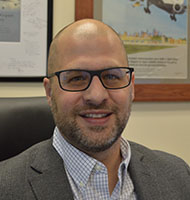 Travis L. DeVault, has joined the leadership team of the University of Georgia’s Savannah River Ecology Laboratory. He will serve as associate director for research under Olin “Gene” Rhodes Jr., director of SREL. As associate director for research DeVault will be responsible for overseeing research support functions at SREL, including environmental health and safety, analytical services, research permitting and compliance and animal care.
He has over 13 years of experience working for the U.S. Department of Agriculture’s National Wildlife Research Center in Sandusky, Ohio and in Syracuse, New York. In his most recent position, he served as supervisory research wildlife biologist and project leader.
His professional experience includes teaching at Purdue University and serving as adjunct faculty at Cornell University and Mississippi State University. He was a visiting graduate researcher at SREL from 2000 to 2003.
DeVault earned a bachelor of science degree and a master of arts degree in life sciences from Indiana State University and a doctoral degree in wildlife ecology from Purdue University. He has authored over 100 peer-reviewed scientific publications.
His research covers wildlife ecology, conservation and behavior with a focus on the causes and consequences of animal-vehicle collisions, and the development of tools and strategies to reduce these collisions. His research also investigates human-wildlife interactions, managing damage caused by wildlife and ornithology.
DeVault is the recipient of numerous awards and accolades, including receiving the USDA’s National Wildlife Research Center’s Researcher of the Year Award for 2017, three Outstanding Publication Awards and Airport Business magazine’s “Top 40 Under 40.”
In addition to working with the USFS-SR, SREL partners with other organizations like the STEM Community Coalition, a national grant-awarded program developed to reach students in rural and low-income communities that are underserved in science education.
According to Alix Ambriz, education specialist for the AFBFA, the team’s approach caught their attention.
Bullfrog tadpoles reached what the researchers describe as maximum threshold, or the point at which their uptake of the contaminant stopped, between 11 and 14 days.
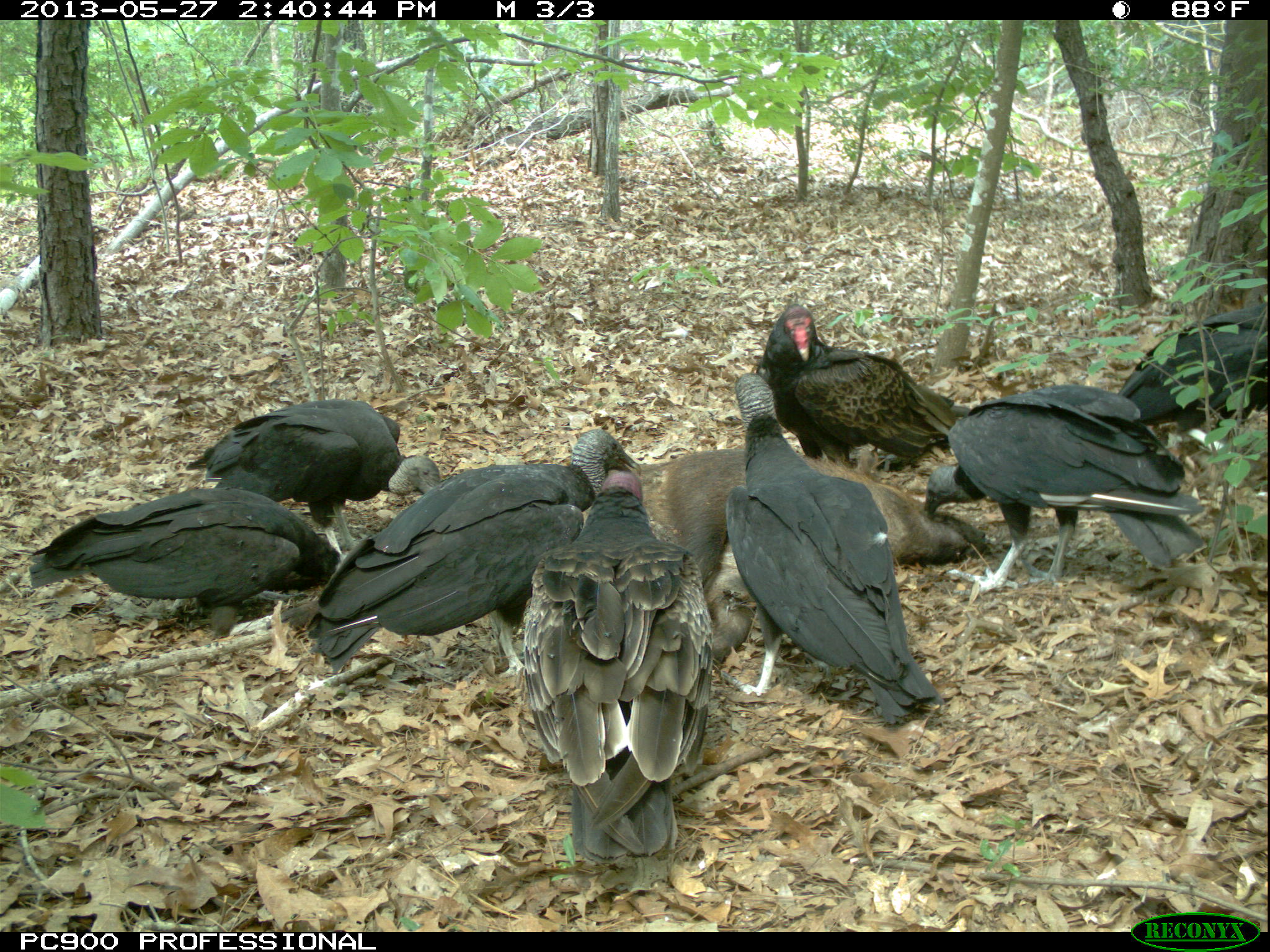
Both turkey and black vultures discover and partake in this feast. (Photo by James Beasley)
Two species of vulture—the turkey vulture and the black vulture—are able to coexist because their respective traits reduce the need for them to compete for nutritional resources, according to a study by University of Georgia researchers.
In North America, humans frequently see vultures on the side of the road and view them as wild scavengers. This vantage point doesn’t attribute the species with value. Yet, in other parts of the world like Asia –where population declines in vultures have given rise to diseases like rabies, the value of their role as scavengers in an ecosystem is quite clear. Vultures serve as garbage disposals, eliminating rotting flesh and reducing the spread of diseases.
A team of UGA researchers investigated how the turkey vulture and the black vulture—which have similar outward appearances—are able to coexist in a geographic region based on unique physical traits, skills and behavioral characteristics.
The team was led by Mike Byrne, a postdoctoral researcher at the Savannah River Ecology Laboratory at the time of the study. Rabbit and pig carcasses were placed as bait in open canopy and forested habitats. Byrne used an advanced GPS tracking system with high-resolution capability and remote cameras to examine the birds’ foraging behavior and movement patterns.
The turkey vulture’s body mass relative to its wing surface area is much lighter than a black vulture’s, according to Byrne, now an assistant professor of wildlife ecology at the University of Missouri. This physical trait allows them to soar more efficiently than black vultures, enabling them to cover a larger land mass and zoom in on small carcasses.
Their keen sense of smell, coupled with their flight skills, means that they’re the first to arrive at the buffet. The study revealed that turkey vultures arrived first at 94% of the carcasses.
But black vultures are adept at foraging larger carcasses, and they have other traits that allow them to successfully compete with turkey vultures, according to James Beasley, Byrne’s supervisor at the time of the study.
“Black vultures are much more social than turkey vultures,” said Beasley, associate professor at SREL and the Warnell School of Forestry and Natural Resources. “They are able to locate potential carrion by keying in on the movements of turkey vultures or through communication at communal roosts, and then they usurp larger carrion from turkey vultures through their more aggressive nature.”
Understanding how functionally similar vulture species are able to coexist can provide insight to European conservationists, who are using feeding programs to offset population declines, the researchers said.
The study, published in Ecosphere, is available at https://esajournals.onlinelibrary.wiley.com/doi/full/10.1002/ecs2.2548
Additional authors on the study are Amanda Holland, University of Georgia’s Savannah River Ecology Laboratory, Aiken, South Carolina; College of Forestry, Oregon State University, 3100 SW Jefferson Way, Corvallis, Oregon, 97333; Kelsey Turner, SREL; Warnell School of Forestry and Natural Resources; USDA-APHIS-WS, 400 Northeast Drive, Suite L, Columbia, South Carolina, 29203; and Albert Bryan, SREL.