
Augusta University Students Become Ecologists for a Day at SREL
By Tyjaha Steele

The visiting ecology class watches as Amanda Hurst talks about the ants they just found. (Photo courtesy of Tyjaha Steele)
Students from Augusta University recently joined the Savannah River Ecology Laboratory (SREL) for its Ecologist for a Day program, stepping outside the classroom and into the field to explore the natural world firsthand. Students from Dr. Susan Blas’s class spent the day at the University of Georgia’s SREL Conference Center in Aiken, South Carolina, where they joined SREL Outreach Coordinators Amanda Hurst and Sean Poppy for a hands-on ecological learning experience.
Hurst, an Augusta University alum, now serves as an outreach coordinator at SREL, where she helps connect students and the public with ecological research and environmental education. Her background at Augusta University makes opportunities like this a meaningful way to reconnect with her alma mater while introducing current students to the practical applications of environmental science and the work of SREL.
The Ecologist for a Day program has been offered by SREL since 1995, providing students with an opportunity to experience what it is like to work as an ecologist. Designed for students ages 6 and older, the program encourages environmental awareness and appreciation through real-world ecological investigations. Because the program takes place outdoors, each visit offers a unique experience shaped by the ecosystems explored and the discoveries made along the way.

Students are seen looking for different specimen in water collected from one of the wetlands. (Photo courtesy of Tyjaha Steele)
During their visit, students joined Hurst and Poppy for an outdoor exploration along the trails surrounding the Conference Center. As they made their way through the wooded landscape, students learned how ecologists observe and investigate the environment, using field-based approaches to examine the biodiversity found throughout the region. The experience highlighted how scientists measure, count, and identify organisms while studying the relationships between living things and their surrounding habitats.
Rather than simply learning about ecology from a textbook, students had the opportunity to engage directly with the natural environment. The trail provided a setting for discussing the diversity of organisms that inhabit local ecosystems and demonstrating how field observations contribute to a broader understanding of ecological systems. Experiences like these help students connect scientific concepts with the environments they encounter in the real world.
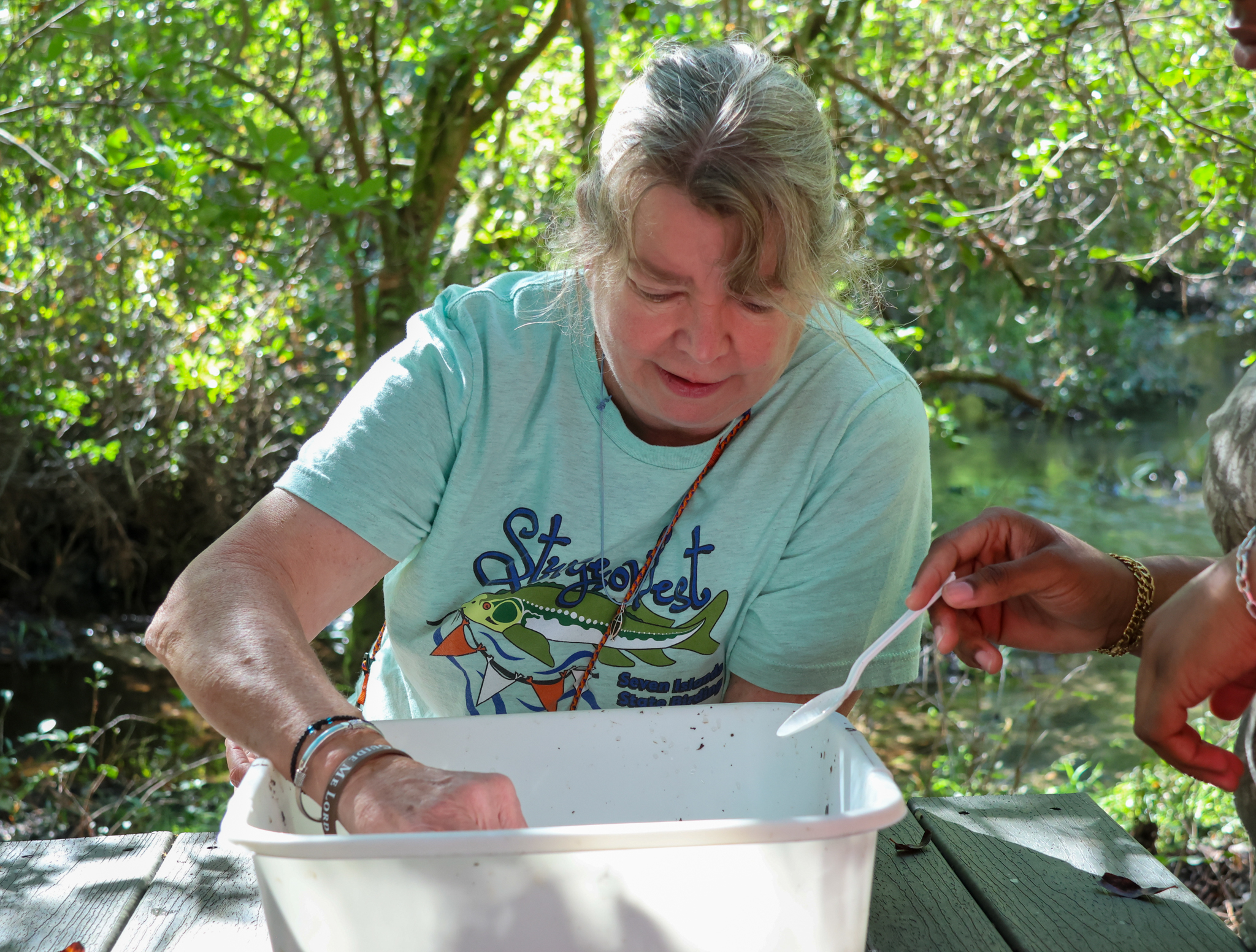
Susan Blas is seen assisting students and identifying different specimens found in the bucket from the wetland water. (Photo courtesy of Tyjaha Steele)
Dr. Susan Blas, an assistant professor in the Department of Biological Sciences at Augusta University’s College of Science and Mathematics, brought her students to SREL to participate in this field-based learning experience. The visit provided an opportunity for students to engage with SREL’s outreach professionals and learn more about ecological fieldwork beyond the university classroom.
Through their time in the field with Hurst and Poppy, students gained a closer look at the work ecologists do to understand and preserve the natural world. From exploring local habitats to learning how scientists investigate biodiversity, the experience offered a practical introduction to ecological research and the many ways environmental science can be applied to real-world conservation challenges.
Through programs like Ecologist for a Day, SREL continues to connect students with the natural world while encouraging curiosity, scientific exploration, and an appreciation for the ecosystems that make the Savannah River region unique.